Trigger Point Pain: What It Is, Why It Won't Go Away, and How to Treat It Naturally
Trigger Point Pain: What It Is, Why It Won't Go Away, and How to Treat It Naturally

Muscle pain that just won't quit — no matter how much you rest, stretch, or apply heat — may not be a mystery after all. It may be a trigger point.
Trigger points are one of the most underdiagnosed sources of chronic muscle pain, yet they affect millions of people dealing with everything from stubborn neck tightness to deep hip aches and between-the-shoulder-blades tension that no amount of massage seems to touch. If you've been told "it's just stress" or "try stretching more," this article is for you.
What Is a Trigger Point?
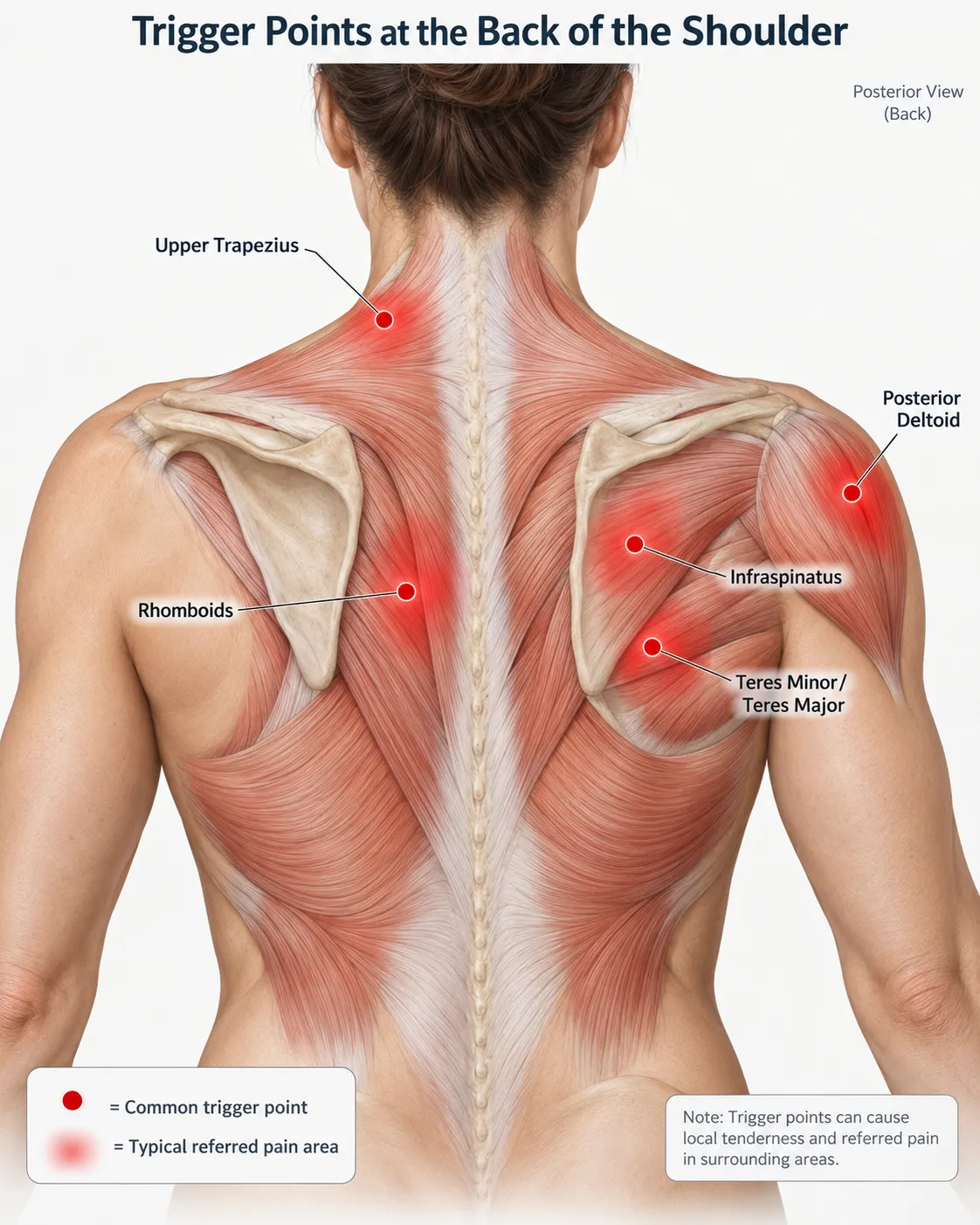
A trigger point — sometimes called a muscle knot — is a hyperirritable spot within a taut band of skeletal muscle fiber. When pressure is applied, it produces both local tenderness and a predictable pattern of referred pain: discomfort that radiates to a seemingly unrelated area.
This referred pain is what makes trigger points so confusing. A trigger point in your upper trapezius can send pain up the side of your neck and behind your eye. A point in your glute can mimic sciatica down the back of your leg. Your pain may be felt somewhere entirely different from where it originates.
Trigger points form when a muscle is overloaded — through repetitive motion, sustained posture, acute injury, or even emotional stress. The affected fibers go into a sustained contraction they can't release on their own, cutting off local circulation and creating a self-perpetuating cycle of pain and dysfunction.
Why Trigger Points Don't Resolve on Their Own
Here's the frustrating truth: most conventional advice for muscle pain — rest, ice, OTC pain relievers — doesn't address the underlying contraction. You may get temporary relief, but the trigger point remains.
Stretchingcan actually aggravate active trigger points if done aggressively, pulling on already-strained fibers without releasing the central knot.
Foam rollingmoves across the surface of the muscle but rarely applies sustained, targeted pressure to the specific spot where the contraction lives.
Restremoves the aggravating activity, but the trigger point itself stays locked — sometimes for months or years — until it's directly addressed.
What trigger points need is a combination of targeted mechanical input, improved local circulation, and reduced inflammation in the surrounding tissue.
A Natural Approach to Trigger Point Relief
Effective trigger point treatment works on multiple levels simultaneously. Here's the framework our recovery protocol is built around:
1. Targeted Pressure TechniquesSustained, direct pressure to the trigger point — held for 30–90 seconds — signals the nervous system to release the contraction. This can be done with a therapist's thumb, a massage ball, or a purpose-built tool. The key isspecificity: finding the exact spot, not just the general area.
2. Topical Anti-Inflammatory SupportReducing localized inflammation in the muscle tissue makes sustained pressure more effective and accelerates tissue recovery between sessions. A high-quality topical with proven botanicals — arnica, menthol, or camphor-based formulas — can meaningfully reduce the sensitivity of active trigger points and support circulation in the affected area.
3. Movement ReintegrationOnce the trigger point begins to release, gentle, deliberate movement helps re-educate the muscle. This isn't aggressive stretching — it's slow, controlled range-of-motion work that reinforces the new length and prevents re-activation.
4. Addressing the Root CauseTrigger points almost always have a contributing factor: a postural habit, a repetitive motion at work, a movement compensation from an old injury. Without identifying and addressing that driver, trigger points tend to return. This is where a personalized recovery protocol becomes essential.
When to Escalate Beyond Self-Care
Self-treatment works well for mild to moderate trigger points in accessible muscles. But there are situations where a guided recovery plan makes all the difference:
Pain has persisted for more than 4–6 weeks despite self-care
You have multiple active trigger points creating overlapping referred pain patterns
The trigger point is in a deep or hard-to-reach muscle (psoas, subscapularis, deep hip rotators)
You're not sure whether what you're feeling is a trigger point, joint pain, or nerve involvement
In these cases, a physical-therapist-informed consultation helps you build a targeted, sequenced plan — so you're not guessing.
The Restauré Botanicals Approach
Our Trigger Point Recovery protocol was developed with exactly this complexity in mind. It pairs targeted topical support with a structured recovery framework designed to release active trigger points, reduce the inflammatory environment that keeps them stuck, and restore full, pain-free function.
Whether you're dealing with a single stubborn knot or a full-body pattern of myofascial dysfunction, the right plan — built around your specific presentation — is the difference between managing pain and actually resolving it.
Explore the Trigger Point Recovery Protocol →Not sure where to start? Book a Recovery Consultation →
“Don't assume you can't get getter. Investigate. Understand your body and give it a chance to recover."— Dr. Adina Verrett, PT, DPT
Final Thoughts
Trigger point pain is real, it's common, and it's treatable — but it requires the right approach. Rest and generic stretching rarely get you there. Targeted pressure, topical support, and an understanding of what's driving the pattern will.
If chronic muscle pain has been limiting your movement, your sleep, or your quality of life, you don't have to keep guessing. A clear, personalized recovery plan is within reach.
This article is for educational purposes and does not constitute medical advice. Please consult a qualified healthcare provider for diagnosis and treatment of musculoskeletal conditions.